article
How to write website copy your customers understand
Practical advice for writing clear, confident website copy that explains what you do and helps customers know what to do next.
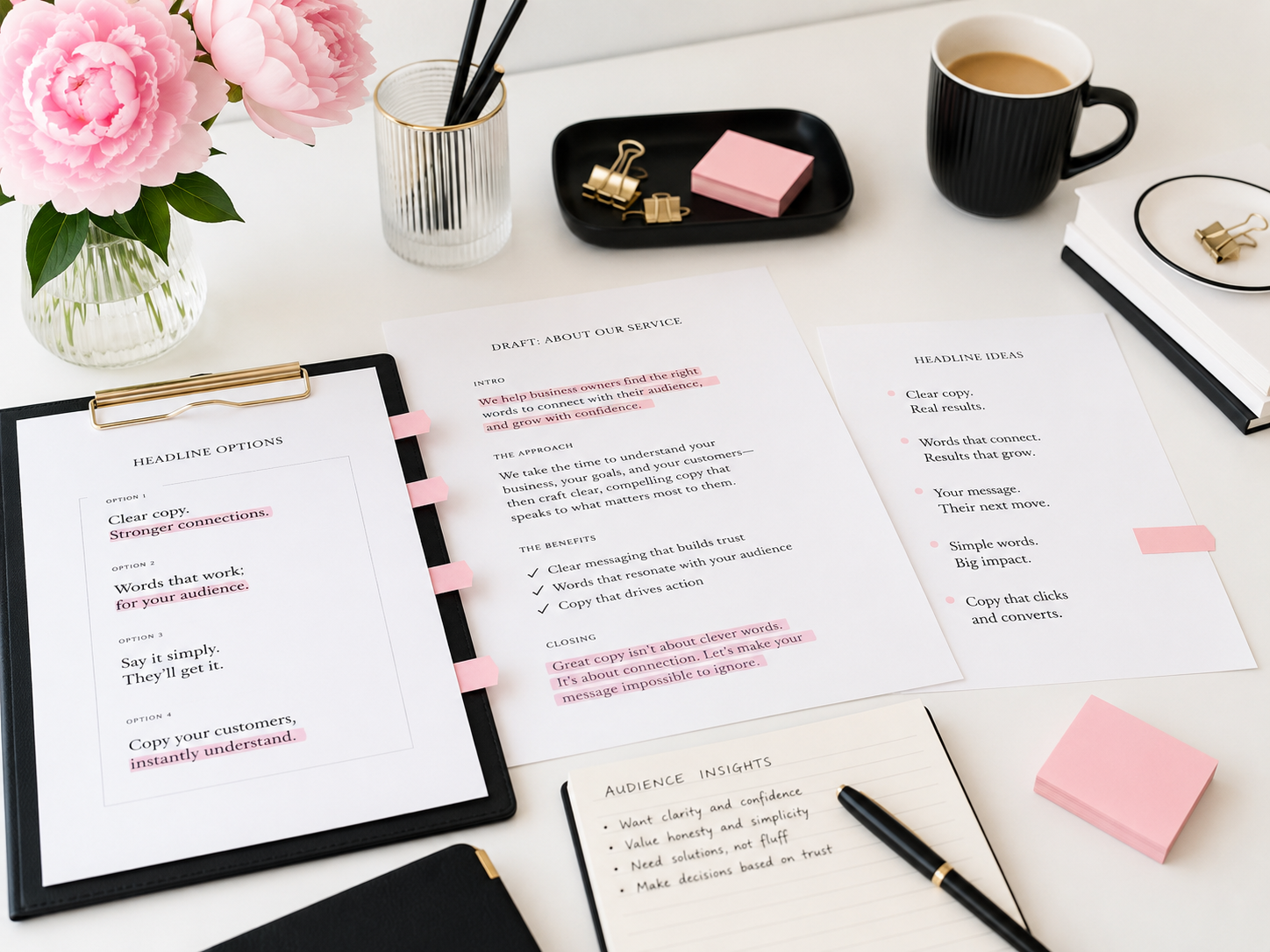
Website copy is the written content that guides people through your website.
It explains what your business does, who it helps, what you offer and what somebody should do next.
Good website copy does not need to sound clever or overly polished.
It needs to be clear, useful and easy for your customers to understand.
Write for your customer, not your business
When you know your business well, it is easy to assume that customers understand the same words, services and processes that you do.
They often do not.
Your website should explain things from the customer’s point of view.
Instead of beginning with everything you want to say about the business, think about what the visitor needs to know.
They may be asking:
- Am I in the right place?
- Does this business offer what I need?
- Do they work with people like me?
- Can I trust them?
- How much does it cost?
- What happens next?
- How do I get in touch?
Strong website copy answers those questions clearly.
Make the first message easy to understand
The top of your homepage should quickly explain what your business offers.
A visitor should not have to search through several paragraphs to work it out.
We help shape this for every project as part of our business website design service.
A clear opening message usually includes:
- what you provide
- who it is for
- the main benefit
- a clear next step
For example, instead of writing:
“Delivering innovative, customer-focused solutions with passion and excellence.”
You could write:
“Professional websites for small businesses, sole traders and local organisations.”
The second version is less decorative, but far more useful.
Avoid vague business language
Many websites use phrases that sound professional but do not explain anything specific.
Examples include:
- tailored solutions
- exceptional service
- industry-leading expertise
- your trusted partner
- going above and beyond
- quality you can rely on
- innovative solutions
- customer-focused service
These phrases are not always wrong, but they are often too vague on their own.
Show what makes the business useful rather than relying on broad claims.
Instead of:
“We provide tailored solutions for every customer.”
Try:
“We recommend the website structure and features that suit your business, rather than forcing every project into the same package.”
Specific language feels more believable.
Use the words your customers use
Your customers may not use the same terminology as people within your industry.
Technical language, abbreviations and professional terms can make a website harder to understand.
Where specialist language is necessary, explain it.
For example:
“Responsive design” may mean something to a web designer.
A customer may understand this more easily as:
“Your website will adjust properly across mobiles, tablets and desktop screens.”
Clear language does not make your business sound less professional.
It makes your expertise easier to understand.
Keep sentences manageable
Long sentences can become difficult to follow, particularly on a mobile screen.
Aim for one main point at a time.
Break longer explanations into shorter paragraphs and use headings to guide the reader.
This does not mean every sentence needs to be extremely short.
It means the reader should not have to work hard to understand what you are saying.
Use headings that explain the section
Headings should help somebody scan the page and understand its structure.
Avoid headings that are clever but unclear.
Instead of:
“Where ideas become reality”
A clearer heading may be:
“Website design for growing businesses”
Instead of:
“Let us make it happen”
You could use:
“How the website process works”
Useful headings improve both readability and navigation.
Focus on benefits as well as features
A feature explains what something includes.
A benefit explains why that matters to the customer.
For example:
Feature:
“Mobile-responsive website design.”
Benefit:
“Your website will be easy to use on mobiles, tablets and desktop screens.”
Feature:
“Online booking integration.”
Benefit:
“Customers can choose and book an available appointment without waiting for a reply.”
Both pieces of information are useful.
The feature tells the customer what they are getting, while the benefit explains why it helps.
Be specific where possible
Specific information builds more trust than general promises.
Instead of:
“Fast turnaround.”
You could write:
“Most straightforward business websites are completed within an agreed project time frame once all required content has been received.”
Instead of:
“Affordable prices.”
You could write:
“Website packages start from £395, with the full cost agreed before work begins.”
Specific wording helps customers understand what to expect.
Explain the next step
Every important page should make it clear what the visitor can do next.
That may be:
- start an enquiry
- complete a Discovery Form
- request a quote
- book an appointment
- browse products
- view previous work
- contact the business
- download information
A call to action should be clear and direct.
Examples include:
- Start Your Discovery
- Discuss Your Website
- Request a Quote
- View Our Work
- Book an Appointment
- Ask a Question
Avoid making customers guess what will happen after they click.
Do not try to say everything at once
A homepage does not need to contain every detail about the business.
Its job is to guide people towards the most relevant information.
More detailed explanations can be placed on:
- service pages
- product pages
- frequently asked questions
- portfolio pages
- guides or resources
- contact pages
Trying to fit everything onto one page can make the most important messages harder to find.
Write naturally
Website copy should sound like the business, not like a generic marketing template.
Read the words aloud.
Ask yourself:
- Would I actually say this?
- Does it sound like my business?
- Is anything exaggerated?
- Is the meaning clear?
- Would a customer understand it?
- Does it feel helpful rather than pushy?
Natural writing often feels more trustworthy than language designed to impress.
Show evidence rather than making claims
Anybody can say they are reliable, experienced or professional.
Where possible, support those claims with evidence.
That may include:
- examples of completed work
- testimonials
- qualifications
- years of experience
- clear processes
- transparent pricing
- photographs
- case studies
- guarantees
- recognised memberships
Instead of repeatedly saying that the business is trustworthy, give customers reasons to reach that conclusion themselves.
Keep important information easy to find
Do not hide useful details behind vague wording.
Customers may need to know:
- the area you cover
- opening hours
- starting prices
- delivery options
- appointment availability
- who the service is suitable for
- what is included
- how long the process takes
- how to contact you
Clear information can prevent unnecessary questions and help the right customers make decisions more confidently.
Use lists carefully
Lists are useful when information needs to be scanned quickly.
They work well for:
- services
- features
- benefits
- package inclusions
- steps in a process
- frequently asked questions
- documents or information required
Do not turn every paragraph into a list.
Use them where they genuinely make the content easier to understand.
Think about mobile readers
Many customers will first view your website on a phone.
Large blocks of text can feel overwhelming on a smaller screen.
Use:
- clear headings
- shorter paragraphs
- sensible spacing
- useful lists
- obvious buttons
- straightforward language
The copy should remain easy to follow without requiring somebody to read every word.
Remove unnecessary words
Once the first draft is written, read through it and look for anything that can be simplified.
For example:
“Please do not hesitate to get in contact with us if you would like to discuss your requirements further.”
Could become:
“Contact us to discuss what you need.”
“Due to the fact that” can usually become “because.”
“At this moment in time” can usually become “now.”
Removing unnecessary words makes the message stronger.
Keep the tone consistent
Your website should sound like the same business from one page to the next.
That does not mean every sentence needs the same style.
It means the overall tone should remain recognisable.
Your tone might be:
- warm and approachable
- clear and straightforward
- calm and reassuring
- polished and editorial
- professional and practical
- friendly and conversational
Choose a tone that suits both your business and your customers.
Answer common concerns
Good website copy does more than describe the service.
It also reassures people about the questions or worries that may stop them taking the next step.
That may include:
- whether they need technical knowledge
- whether prices are agreed in advance
- whether they can make changes later
- whether support is available
- what information they need to provide
- whether the service suits a new business
- what happens after an enquiry
Answering these concerns clearly can make the customer journey feel easier.
You do not need to write perfectly
Many business owners struggle with website copy because they believe the first draft needs to be polished.
It does not.
Begin with straightforward answers to simple questions:
- What does the business do?
- Who does it help?
- What services or products are available?
- What makes the approach different?
- What does the customer need to know?
- What should they do next?
Clear information can always be refined.
It is much easier to improve an honest first draft than to work with a blank page.
Good website copy makes things easier
The purpose of website copy is not to impress people with complicated language.
It is to help them understand your business, find the information they need and feel confident about taking the next step.
The strongest copy is usually:
- clear
- specific
- useful
- easy to scan
- written with the customer in mind
- consistent with the business
- honest about what happens next
When customers understand what you offer and why it is relevant to them, the website is doing its job.